
For decades, investing had a quiet inequality problem: the best companies often cost thousands of dollars per share, and a young investor with $100 a month could not buy a single share of them. Fractional shares changed that. Today, nearly every major brokerage lets you buy a fraction of a share, making a $50,000-per-share stock available for $5. The change sounds small, and it has quietly rewritten how ordinary people build portfolios.
What Fractional Shares Are
A fractional share is exactly what it sounds like: a piece of a share, representing partial ownership of a company. If a stock trades at $2,000 and you invest $200, you own one-tenth of a share. You receive the same percentage returns, dividends, and voting rights per share as a full holder; you just own less of them. The brokerage handles the accounting, and the position shows up in your account like any other holding.
Fractional shares are bought through brokerages, not directly from companies, and they work for ETFs and index funds as well as individual stocks. That last point is the quiet revolution: an ETF like the S&P 500 costs hundreds of dollars per share, and fractional investing lets a $50 contribution spread across the entire index.
Why Fractional Investing Matters
The first benefit is access. The most successful companies of the last two decades, think of any stock that split its way to five figures, were effectively closed to small investors. Fractional shares open the entire market to any budget, which matters for diversification: instead of choosing between one expensive stock and a cheap one, you can own a little of both.
The second benefit is precision. A full share forces you to buy in lumps: $2,000, $4,000, $6,000. Fractional shares let you invest exactly what you have, so every dollar is deployed the day it is available. That matters more than it sounds, because money sitting in cash earns nothing while it waits for a full share. The third benefit is automation: dollar-cost averaging works perfectly with fractional shares, because your fixed monthly amount buys the exact same dollar value every month regardless of price.
The Costs and Limits to Know
Fractional shares come with caveats. Not every brokerage offers them, and among those that do, the features vary: some allow fractional ETFs but not fractional stocks, and some do not support fractional transfers or dividend reinvestment for fractions. Check before you commit. Fractional holdings are also less portable; transferring a fractional position to another brokerage can force you to sell the fraction or round it up.
Taxes work the same as full shares: you owe capital gains when you sell, and the cost basis is tracked per fraction. Some brokerages handle the bookkeeping seamlessly, while others require manual tracking, so keep your statements.
The Strategy That Fits
For most investors, fractional shares are best used for index funds and ETFs, where they enable a fully diversified portfolio from the first dollar. They also serve a second role: building a “play portfolio” of individual stocks you believe in, with amounts small enough that a mistake costs little. The discipline that matters is the same as with any investing: set a plan, automate contributions, and do not panic-sell.
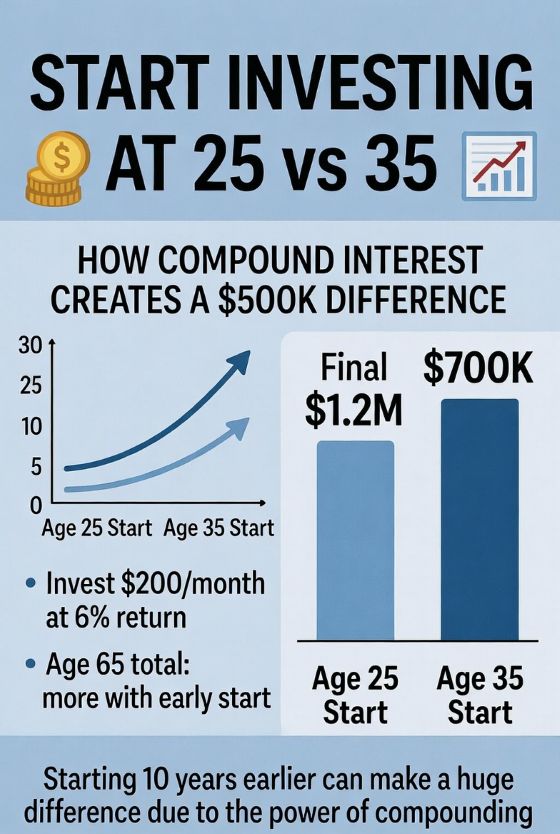
Fractional shares do not make investing easier to win; they make it easier to start, and starting earlier is the closest thing to a guaranteed edge in the market. A portfolio built of $25 pieces, automated monthly, compounds exactly like a portfolio built of $25,000 lumps. The math does not know the difference, and neither does your future self.