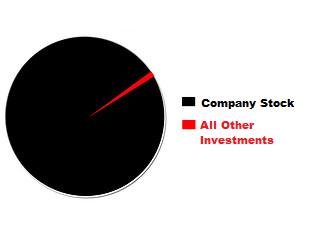
When Enron collapsed in late 2001, employees didn’t just lose their jobs. They lost their retirement savings too. The average 401(k) at Enron held 62% company stock — and when shares fell from $90 to under $1 in a single year, thousands of workers discovered they had no financial floor left.
That was 25 years ago. The lesson still hasn’t landed.
Vanguard’s retirement plan data shows that participants with access to employer stock hold an average of 14% in it — nearly three times the 5% ceiling most certified financial planners recommend. A meaningful percentage hold 30%, 40%, or more. If you receive stock through RSUs, an ESPP, a 401(k) match, or options, there’s a reasonable chance you’re in that group.
The purpose of this article is simple: help you figure out whether your allocation is dangerously high, explain why it matters more than most people think, and show you what to actually do about it.
Why Financial Planners Cap Company Stock at 5–10%
The ceiling isn’t arbitrary. It comes from looking at what happens when single-stock concentration meets a bad year — and the math is asymmetric in a way that compounding makes brutal.
Individual stocks carry volatility that diversified funds don’t. A single stock can lose half its value in twelve months without the company doing anything catastrophically wrong. The S&P 500 has dropped 50% or more exactly once in the past century. Individual companies — Enron, WorldCom, Lehman Brothers — have gone to zero. The index absorbs those losses and moves forward. A concentrated holder does not.
Concentration Risk by Allocation: What the Numbers Show
| Company Stock Allocation | Loss if Stock Drops 50% | Loss if Stock Goes to Zero | Gain Needed Just to Recover |
|---|---|---|---|
| 5% | 2.5% portfolio loss | 5% portfolio loss | ~5% |
| 15% | 7.5% portfolio loss | 15% portfolio loss | ~18% |
| 30% | 15% portfolio loss | 30% portfolio loss | ~43% |
| 50% | 25% portfolio loss | 50% portfolio loss | ~100% |
That asymmetry matters more than people realize. A 30% loss requires a 43% gain just to break even — not a 30% gain. A 50% loss requires doubling your money to recover. Concentration risk doesn’t just increase how much you can lose. It lengthens how hard recovery becomes, often by years.
The Familiarity Trap Behind Over-Concentration
Most employees who hold too much company stock aren’t reckless. They’re confident. They work there. They see the products, know the leadership, believe in the roadmap. That familiarity is understandable — and financially irrelevant to future returns.
Behavioral researchers call this familiarity bias. Studies consistently show that employees rate their own employer’s stock more favorably than outside analysts do. Companies that employees loved and believed in have failed at the same rate as companies employees were ambivalent about. The confidence isn’t rewarded by outcomes.
Your opinion of your company’s leadership is not a diversification strategy.
Your Paycheck Is Already a Bet on Your Employer
This is the piece most people miss entirely — and it changes the calculation more than almost any other factor.
Financial planners talk about human capital as an asset: the present value of your future earnings. If you’re 35, earning $90,000 a year, planning to work for 25 more years, the present value of those earnings runs into the millions. Every dollar of it is tied to one employer. Your portfolio should be offsetting that concentration, not compounding it.
Why Correlation Is the Real Risk
When your employer struggles financially, two bad things happen simultaneously. The stock price drops. And your job security weakens. If the company fails, you lose both your paycheck and your investment at the same moment — exactly what Enron and Lehman Brothers employees experienced when their companies imploded.
This is what makes employer stock different from any other single-stock risk. If you hold 20% of your portfolio in Microsoft and Microsoft has a bad quarter, your career almost certainly continues unchanged. But if your employer has a bad quarter, your salary, bonus, promotion prospects, and potentially your job are all in jeopardy at the exact same time your portfolio is falling.
The correlation between your human capital and your employer’s stock price is close to 1.0. That’s not diversification. That’s the opposite of it.
Industries Where This Risk Hits Hardest
The correlation problem is worst in volatile industries. Tech, finance, energy, and biotech — sectors where companies can swing from aggressive hiring to mass layoffs in a single quarter — create especially sharp alignment between employment outcomes and stock performance.
Pharmaceutical employees learned this firsthand when FDA rejection decisions wiped out stock value and triggered layoffs in the same week. Energy sector workers saw it during the 2014–2016 oil crash, when both jobs and employer stock collapsed across the industry simultaneously. Tech employees experienced a version of it during the 2026 rate-shock cycle, when valuations dropped 40–70% and mass layoffs followed at companies that had seemed untouchable twelve months earlier.
The more cyclical your industry, the more your salary and your employer stock move together. Which means the more critical diversified assets elsewhere become.
A Quick Way to Size Your Real Exposure
Add your employer stock holdings to three times your annual salary — a rough proxy for the present value of near-term earnings at risk. A person earning $100,000 with $50,000 in employer stock doesn’t have $50,000 in employer exposure. They have closer to $350,000. That reframe changes how “only 10% of my portfolio is in company stock” actually feels.
Three Mistakes That Keep Employees Overweight in Company Stock
- Treating RSU vesting as a reason to hold, not a decision point. RSUs vest and become yours. The moment they do, you face a real binary choice: sell and diversify, or hold as a deliberate new investment. Most people default to holding — but that default is an active choice. It’s a decision to concentrate further, made passively. Every vest date deserves a deliberate answer to the question: would I buy this stock today with fresh cash? If the answer is no, the default answer should be sell.
- Anchoring to the original grant price. “My shares were granted at $150 and the stock is at $95 — I’ll hold until it recovers.” The grant price is irrelevant to where the stock goes from here. The market doesn’t care what you were promised. Holding while waiting to recover a paper loss is a sunk-cost trap dressed up as patience. It’s one of the most common and most expensive mistakes in equity compensation.
- Holding ESPP shares to capture additional upside. Employee Stock Purchase Plans frequently offer a 10–15% discount on shares, often with a lookback provision that makes the deal even sweeter. That discount is real — it’s essentially guaranteed money. But it’s not a reason to hold the shares after purchase. Most planners recommend selling ESPP shares immediately upon purchase, capturing the guaranteed discount, and redeploying into diversified assets. Holding them turns a guaranteed win into a concentration bet.
Between these three patterns, it’s easy to accumulate a 30–40% employer stock allocation without ever making a conscious decision to do so. The accumulation is passive. The risk is not.
One more worth naming: some 401(k) plans match contributions in company stock and restrict when you can diversify that match. Check your plan documents. If a vesting restriction applies to matched shares, factor them into your total exposure calculation and plan to diversify as soon as the restriction lifts.
How to Sell Company Stock Without a Tax Disaster
Are RSUs taxed again when I sell them?
RSUs are taxed as ordinary income at vesting — the IRS treats them as compensation the moment they become yours. When you later sell the shares, you owe capital gains tax only on appreciation above the vest-day price, which is your cost basis. If you sell immediately after vesting, you typically owe little to no additional tax beyond what was already withheld by your employer.
This makes immediate-sale-at-vest a tax-efficient default for most people. You capture the value, diversify the position, and minimize the additional capital gains liability. It’s not always optimal, but it’s defensible — and it removes the temptation to hold out of inertia.
What about shares I’ve held for over a year?
Shares held longer than twelve months qualify for long-term capital gains rates: 0%, 15%, or 20% depending on your taxable income. That’s significantly better than ordinary income rates, which can run to 37% federally. The lower rate is real money on a large position — worth planning around, not ignoring.
But a tax preference isn’t a reason to maintain dangerous concentration. A 15% capital gains rate is better than a 50% stock loss. The Fidelity NetBenefits platform and the Schwab Equity Award Center both include built-in tax modeling tools for RSU and ESPP sales. Run a scenario before selling a large block. It takes five minutes and removes the guesswork from April’s tax bill.
Does spreading sales out over time help?
Often, yes — both for taxes and for psychology. Selling in regular tranches, quarterly or semi-annually, smooths capital gains across tax years and removes the temptation to time the market. For executives with insider trading restrictions, a formal 10b5-1 trading plan lets you schedule sales in advance, insulating you from compliance risk. For regular employees without those constraints, a simple recurring sell schedule works fine. Automate it if your brokerage allows it. Removing the decision from your hands removes the delay.
What a Properly Diversified Portfolio Looks Like After You Trim
The right target for most working employees: keep employer stock below 5% of total investable assets. Below 10% is the outer limit. Above 10% demands a specific, documented reason — and “I believe in the company” is not that reason.
Once you’ve trimmed the position, the proceeds need somewhere to go. Three funds cover most of what a diversified equity portfolio requires:
- Vanguard Total Stock Market ETF (VTI) — approximately $270 per share, 0.03% expense ratio. Owns every publicly traded U.S. company, weighted by market cap. One fund gives you instant exposure across 3,500+ stocks, with no single name able to destroy the portfolio.
- iShares Core S&P 500 ETF (IVV) — approximately $580 per share, 0.03% expense ratio. Focused on large-cap U.S. companies. For most investors over long time horizons, outcomes are nearly identical to VTI. Either works.
- Vanguard Total International Stock ETF (VXUS) — approximately $65 per share, 0.05% expense ratio. Adds non-U.S. exposure across developed and emerging markets. A 70/30 split between VTI and VXUS gives you a simple, globally diversified equity portfolio that requires almost no ongoing maintenance.
None of these will ever go to zero. None depend on one company’s quarterly earnings report. And all three carry expense ratios so low they’re essentially free to hold for decades.
Before you act, run your current holdings through the Morningstar Portfolio X-Ray tool — free with a basic Morningstar account. It shows exactly what percentage of your total portfolio sits in any single stock, including through fund overlap. If your employer’s name appears in double digits, that’s the number to start reducing.
Your employer is already your largest financial counterparty. Your portfolio’s job is to balance that exposure — not double down on it.
Disclaimer: The information on this page is for educational purposes only and does not constitute financial advice. Rates, terms, and eligibility requirements are subject to change. Always compare multiple lenders and consult a licensed financial advisor before borrowing.