
Your coworker turned $2,000 into $14,000 holding Bitcoin last year. Your neighbor lost $8,000 chasing Solana memecoins over the same stretch. Both stories are true. Both happened in the same market. The difference wasn’t luck — it was position sizing and knowing which assets have a real investment thesis behind them.
Crypto belongs in some personal finance portfolios. Not all of them. And never as the main event.
This guide covers the decisions that actually matter: which cryptocurrencies have a defensible case for inclusion, how much exposure makes sense without threatening your financial goals, which exchanges to trust with your money, and the specific conditions under which skipping crypto entirely is the right call.
Bitcoin, Ethereum, and the Altcoin Tier: A Straight Comparison
More than 20,000 cryptocurrencies exist. Roughly 19,800 of them are dead, dormant, or designed to transfer your money to someone else. The practical universe for a personal finance investor is five assets at most.
| Asset | Market Cap (2026 est.) | Core Investment Thesis | Volatility | Verdict |
|---|---|---|---|---|
| Bitcoin (BTC) | ~$1.3 trillion | Fixed supply (21M cap) digital store of value | High | Most defensible long-term hold |
| Ethereum (ETH) | ~$350 billion | Smart contract infrastructure; DeFi backbone | High | Legitimate; more research required |
| Solana (SOL) | ~$80 billion | High-speed layer-1 blockchain | Very High | Speculative; 1% maximum |
| Memecoins (DOGE, SHIB) | Varies widely | None — pure sentiment speculation | Extreme | Skip entirely |
| Stablecoins (USDC, USDT) | $150B+ combined | Dollar-pegged transfer and yield | Low | Useful tool, not an investment |
Why Bitcoin Leads the List
Bitcoin has one thing no other cryptocurrency can offer: a fixed supply cap of 21 million coins, enforced by code that can’t be changed without consensus from thousands of independent nodes. Combined with a 15-year track record and accelerating institutional adoption, it’s the closest thing crypto has to an established asset class.
The institutional confirmation arrived in January 2026 with US spot ETF approvals. BlackRock’s iShares Bitcoin Trust (IBIT) crossed $50 billion in assets under management within its first year — faster than any ETF in history. Fidelity, Ark Invest, and VanEck launched competing products within weeks. These aren’t retail speculators. These are asset managers running pension capital making deliberate allocations based on a thesis they’ve stress-tested.
The investment logic is straightforward: scarce asset plus growing institutional demand equals price appreciation over long time horizons. Not guaranteed. But it’s a coherent fundamental case, and that distinction matters.
Ethereum’s Case Is Real but More Complex
Ethereum functions as the infrastructure layer for most significant crypto applications — DeFi lending protocols, stablecoin issuance, NFT markets, and decentralized exchanges all run on it. Its value is tied to actual network usage: developers pay ETH fees to run smart contracts, so growing developer adoption drives ETH demand directly.
The complication is competition. Ethereum faces real pressure from Solana, Avalanche, and newer smart contract platforms on speed and transaction cost. Technological platform competition is harder to evaluate than monetary scarcity. Bitcoin investors point to a supply cap and institutional inflows. Ethereum investors are underwriting one technology platform’s continued dominance over its competitors. That’s a legitimate thesis — just a more complex one that deserves deeper research before you allocate capital to it.
Solana, Altcoins, and Where to Draw the Line
Solana dropped from $260 to $8 during the FTX collapse in November 2026, then climbed back above $200 by early 2026. It’s a real project with genuine transaction speed advantages over Ethereum. A 1% portfolio allocation for investors who’ve done the research isn’t irrational. Anything above that and you’re taking on platform-specific technology risk that most retail investors aren’t equipped to evaluate properly.
Memecoins — DOGE, SHIB, and every derivative — have no investment thesis. They’re trading vehicles driven purely by social media sentiment cycles. They don’t belong in any long-term portfolio.
How Much of Your Portfolio Should Be Crypto

The 5% Ceiling and How to Calibrate It
Start with 5% of investable assets as your ceiling. Most fee-only financial advisors who accept crypto as a legitimate portfolio component recommend 1-10%, with 5% as the most common anchor point across different investor profiles.
A rough framework by situation:
- Under 35, high risk tolerance, no major financial needs in the next five years: up to 10% is defensible
- 35-50, standard risk profile, some medium-term goals in sight: 3-5% is the right range
- Over 50 or within 10 years of retirement: 1-3%, or zero — volatility risk to retirement timing is real and compounds asymmetrically
Why Position Size Beats Asset Selection
The math behind the 5% rule makes the logic concrete. At 5% allocation, a total crypto wipeout costs 5% of your portfolio — painful but survivable. A 10x gain, which Bitcoin has delivered across full market cycles, adds 50% to your total portfolio value. That asymmetry is the case for including the position at all.
When Bitcoin dropped 77% from its November 2026 peak to its November 2026 low, a 5% allocation shrank to roughly 1.15% of the portfolio. Uncomfortable. Not a retirement derailment. At 30% crypto concentration, that same drawdown took a total portfolio down by over 23%. Never allocate money you can’t afford to hold through a multi-year bear market without touching it. That discipline matters more than picking the right coin.
Choosing a Crypto Exchange: The Decision That Actually Protects Your Capital
FTX was the world’s second-largest crypto exchange through most of 2026. In November of that year, it collapsed over 72 hours. Roughly $8 billion in customer funds vanished. The founder was convicted on seven counts of fraud and sentenced to 25 years in federal prison. Customers who held assets on the platform lost everything they had there.
This is not an isolated incident. Mt. Gox, Celsius, BlockFi, and Voyager fill out the same failure category. Exchange selection is one of the two or three most consequential decisions you’ll make as a crypto investor.
Coinbase: The Regulated Starting Point
Coinbase is publicly traded on NASDAQ (ticker: COIN), registered with FinCEN, and holds BitLicense in New York. US dollar cash balances are FDIC-insured up to $250,000. The company stores the majority of customer crypto assets in cold storage, separate from hot wallets exposed to internet access.
The fee tradeoff is real: 0.5% to 1.5% per transaction through the standard interface is expensive. Coinbase Advanced — the professional trading interface accessible from the same account login — charges 0.06% to 0.4% per trade, which is far more reasonable for anyone making regular purchases. For investors putting their first $500-$5,000 into crypto, Coinbase is the lowest-friction, highest-accountability entry point available in the US.
Fidelity and ETFs: The Cleanest Path for Existing Brokerage Customers
If you already hold accounts at Fidelity, Schwab, or any major US brokerage, buying Bitcoin exposure through the Fidelity Wise Origin Bitcoin Fund (FBTC) or BlackRock’s IBIT eliminates exchange custody risk entirely. These are standard ETF shares sitting in a brokerage account under normal SIPC protections — the same protections covering your stock positions. Management fees run 0.12-0.25% annually.
The one tradeoff: ETFs give you Bitcoin price exposure, not actual Bitcoin you can move or spend. For investors who want portfolio-level exposure to Bitcoin’s price movements without managing a separate exchange account, this is the simplest and safest path available.
Kraken for Lower Fees; Ledger for Long-Term Self-Custody
Kraken has operated since 2011 without a major security breach — meaningful credibility in an industry with a poor collective track record. Maker/taker fees run 0.16% to 0.26%, substantially cheaper than Coinbase for investors buying on a regular schedule. The interface requires slightly more comfort with trading mechanics than Coinbase but isn’t difficult if you’ve used any standard brokerage before.
For holdings above $10,000 held long-term, a Ledger Nano X hardware wallet (around $149) stores private keys offline and removes exchange custody risk entirely. The responsibility tradeoff is absolute: lose the device and the 24-word seed phrase and the funds are gone permanently — no customer service line, no account recovery process. Self-custody makes sense once you’ve done enough research to manage that responsibility seriously. For beginners, start on Coinbase or use the ETF route through Fidelity.
Four Mistakes That Wipe Out Crypto Investors

Most crypto losses don’t come from picking the wrong asset. They come from four structural and behavioral errors that repeat across every market cycle without exception.
- Buying at peak media coverage. Retail inflows into Bitcoin historically spike at or near price peaks. In November 2026, Bitcoin hit $69,000 and retail trading volume hit all-time highs. By November 2026 it sat at $16,000 — a 77% drawdown from peak. Investors who bought during the media frenzy either held through devastating losses or panic-sold at the worst possible moment. Dollar-cost averaging — buying a fixed dollar amount on a set schedule regardless of price — removes the timing problem entirely. Buying $100 every two weeks for a year is a fundamentally different investment experience than putting $5,200 in all at once during a headline cycle.
- Using leveraged products. Leveraged crypto ETFs and exchange margin accounts exist and work exactly as designed. A 2x leveraged Bitcoin product compounds losses from daily rebalancing in ways that structurally destroy long-term performance even during periods when Bitcoin trends upward. These instruments are wrong for any investor with a multi-year time horizon — full stop.
- Replacing an emergency fund with crypto. A position that drops 40% in a single month cannot reliably serve as a liquidity reserve. Being forced to sell at a 40% loss because the car broke down is one of the most expensive financial experiences a person can manufacture. A high-yield savings account at Marcus by Goldman Sachs or Ally Bank pays 4-5% APY in 2026 and doesn’t lose value in a weekend. Emergency funds belong in cash, not speculative assets.
- Ignoring crypto taxes until April. Every crypto-to-crypto swap in the US is a taxable event. Selling Bitcoin to buy Ethereum triggers capital gains on the Bitcoin position at the time of the trade. The IRS classifies cryptocurrency as property, not currency. Investors who trade frequently without tracking cost basis regularly discover large unexpected tax bills in spring. Koinly and CoinLedger both offer automated tracking for $50-$100 per year. Using one from your first trade costs less than the accounting bill you’ll otherwise face.
When Crypto Is the Wrong Move for Your Finances

Build This Foundation Before Allocating a Single Dollar
Crypto is a satellite position — it belongs on top of a solid financial foundation, not in place of one.
No emergency fund. Three to six months of expenses in a high-yield savings account comes before any speculative investment. Crypto can drop 50% in a bear market that arrives exactly when you need liquidity most. The combination of needing cash during a down market locks in losses that are hard to recover from.
High-interest debt. Paying 22% APR on a credit card while buying Bitcoin is a losing mathematical position before the first trade executes. Bitcoin’s historical long-cycle returns are impressive, but the variance around that average is enormous. The guaranteed 22% return from eliminating credit card debt beats any speculative crypto thesis on a risk-adjusted basis. Pay the card first.
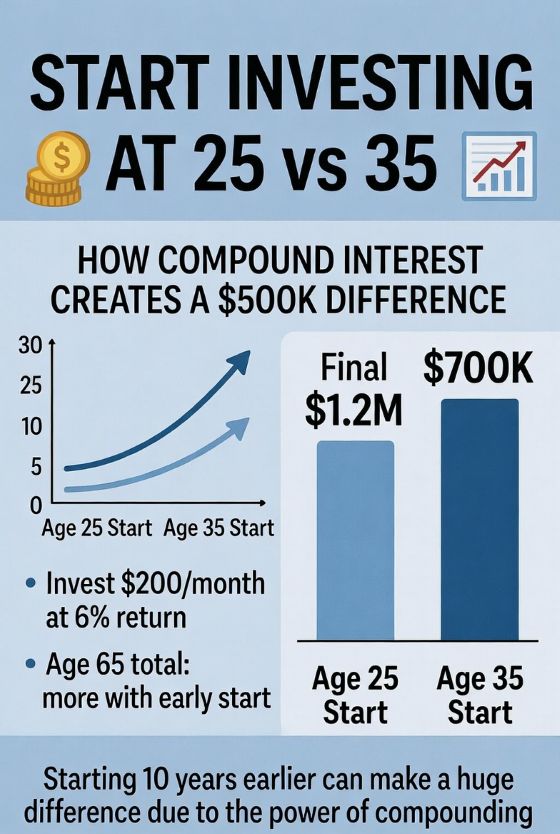
Unfunded tax-advantaged accounts. A 401(k) with an employer match is a guaranteed 50-100% return on the matched dollars — no speculative asset competes with that on a risk-adjusted basis. A Roth IRA ($7,000 annual contribution limit in 2026) offers decades of tax-free compounding. Max the employer match. Fund the Roth. Then decide what’s left over for speculative positions.
The Time Horizon Constraint Is Non-Negotiable
If the money needs to fund a house purchase, tuition, a car, or any financial obligation in the next five years, it doesn’t belong in crypto. Five years is roughly the minimum window over which Bitcoin’s probability of generating positive returns becomes meaningfully favorable based on historical market cycles. Shorter than that, you’re accepting volatility risk on dollars you genuinely need.
Crypto earns its position in the portfolio for investors who have the foundation in place and patient capital to hold through full market cycles. Without that foundation, it’s a distraction from higher-certainty financial moves sitting right in front of you.
Disclaimer: The information on this page is for educational purposes only and does not constitute financial advice. Rates, terms, and eligibility requirements are subject to change. Always compare multiple lenders and consult a licensed financial advisor before borrowing.