You spent three hours comparing two credit cards to save $12 a year in fees. You rebalanced your 401(k) for the fourth time this quarter. You clipped coupons for an hour to save $3.50 on groceries.

That feeling of wasted effort? It has a name. The law of diminishing returns. In economics, it says that after a certain point, each extra unit of input yields less and less output. In personal finance, it means your time, attention, and energy have a limit. Beyond that limit, you are working for pennies an hour.
This article is not about quitting. It is about knowing exactly when to stop optimizing and start living.
What the Law of Diminishing Returns Actually Means for Your Money
The law is simple: add more of one input while holding everything else constant, and eventually the marginal gain shrinks. If you water a plant once, it grows. Water it twice, it grows more. Water it 50 times, it drowns.
In personal finance, the inputs are your time, attention, and money. The output is financial well-being: more savings, less debt, higher returns. The trap is believing that more effort always equals more reward. It does not.
Your First $1,000 of Effort Is Worth More Than Your Next $1,000
The first hour you spend building a budget can save you hundreds of dollars a month. The tenth hour spent tweaking that budget saves you maybe $10. The fiftieth hour? You are probably moving pennies between categories.
Same with investing. The first time you set up automatic contributions to an S&P 500 index fund (VOO, expense ratio 0.03%) is worth years of future returns. The fifth time you check your portfolio in a week? Zero value. Worse than zero — it can trigger emotional trades.
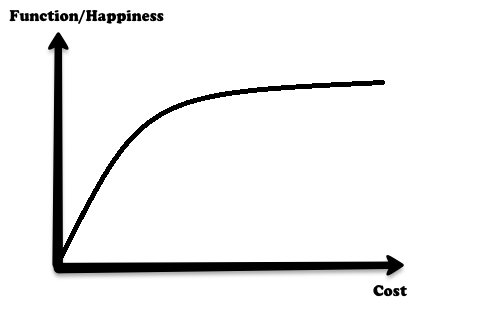
The curve is steep at the start and flat at the end. Most people spend their time on the flat part because it feels productive.
Where Most People Waste Their Time: The Diminishing Returns Zone
Here are the specific areas where extra effort stops paying off. If you recognize yourself in any of these, you are in the zone.
Credit Card Churning Past the Sign-Up Bonus
Churning credit cards for sign-up bonuses can be lucrative. A single bonus from the Chase Sapphire Preferred ($95 annual fee, 60,000 points after $4,000 spend) is worth roughly $750 in travel value. That is a good return on a few hours of work.
But optimizing every single purchase for category bonuses — 3% on dining, 2% on groceries, 5% on rotating categories — when you spend $500 a month? The difference between a 2% cash-back card (Citi Double Cash) and a perfectly optimized 5-card setup is maybe $10 a month. For an hour of mental overhead every week. That is $2.50 an hour.
Bottom line: Chase the big bonuses. Ignore the micro-optimizations. One good sign-up bonus beats a year of category juggling.
Micromanaging a Diversified Portfolio
A standard three-fund portfolio — total US stock (VTI, 0.03% ER), total international stock (VXUS, 0.07% ER), total bond (BND, 0.03% ER) — is simple and effective. Rebalance once a year. Done.
Some people rebalance quarterly. Some try to time the market. Some hold 15 different ETFs hoping for an edge. The data says otherwise. Over the last 20 years, a simple VTI + VXUS + BND mix with annual rebalancing matched or beat 85% of actively managed funds. The extra effort of frequent rebalancing and sector tilting added zero net benefit for most retail investors.
Failure mode: Over-management leads to behavioral mistakes. Selling in a panic, buying high, chasing last year’s winners. The biggest risk to your portfolio is not the market — it is your own hands.
When to Stop Optimizing Your Budget (and What to Do Instead)
Budgeting has a clear point of diminishing returns. The first pass — tracking where your money goes for 30 days — is eye-opening. You see the $200 on takeout, the $150 on subscriptions you forgot about. Fixing those leaks is high-value work.
But once you have the big categories under control, further optimization is a waste. Cutting your coffee budget from $40 to $30 a month saves $120 a year. That is real. But spending two hours a week finding cheaper coffee? The return drops fast.
Here is the rule: if optimizing a category saves less than $20 a month, stop. Your time is worth more than that. Use the time to increase your income instead.
| Budget Category | Time Spent Optimizing | Potential Monthly Savings | Effective Hourly Rate | Verdict |
|---|---|---|---|---|
| Housing (rent/mortgage) | 5 hours (research, negotiate, move) | $200–$400 | $40–$80/hr | Worth it |
| Groceries (meal planning, coupons) | 3 hours/week | $30–$50 | $2.50–$4/hr | Not worth it |
| Insurance (shop annually) | 2 hours/year | $20–$50 | $10–$25/hr | Worth it once a year |
| Subscriptions (audit quarterly) | 30 minutes/quarter | $15–$30 | $30–$60/hr | Worth it |
| Coupon clipping (weekly) | 1 hour/week | $5–$10 | $1.25–$2.50/hr | Stop doing this |
The real move: automate your savings, set a simple 50/30/20 budget (needs, wants, savings), and then focus on earning more. A $5,000 raise from a side project or negotiation dwarfs $200 in coupon savings.
Diminishing Returns in Debt Repayment: The Snowball vs. Avalanche Debate
Two popular methods exist for paying off debt. The avalanche method targets the highest interest rate first. The snowball method targets the smallest balance first. Both work. Both have diminishing returns if you over-optimize.
Avalanche: Mathematically optimal. Paying off a 22% APR credit card before a 6% car loan saves more money over time. But if the credit card balance is $8,000 and the car loan is $2,000, it might take months to see progress. Motivation drops.
Snowball: Psychologically effective. Paying off the $2,000 car loan first gives you a quick win. You feel momentum. But you pay more interest in the long run — potentially hundreds of dollars.
The diminishing returns trap is splitting hairs between the two. People spend weeks debating which method is better, then do nothing. The difference between avalanche and snowball on a $15,000 debt pile at 18% vs. 6% is roughly $300 over two years. That is real money, but it is not life-changing.
Verdict: Pick the method that keeps you motivated. The best debt repayment plan is the one you actually follow. If you need quick wins, snowball. If you are disciplined and numbers-driven, avalanche. Do not let perfect be the enemy of done.
When More Money Stops Making You Happier
This is the most uncomfortable application of diminishing returns. Research from Kahneman and Deaton (2010) and later studies shows that emotional well-being improves with income up to roughly $75,000–$100,000 per year (adjusted for inflation, call it $95,000–$120,000 in 2026). Beyond that, more money does not meaningfully increase day-to-day happiness.
This does not mean money stops mattering. It means the marginal happiness from each additional dollar shrinks. A person earning $50,000 who gets a $10,000 raise feels a significant life improvement. A person earning $200,000 who gets a $10,000 raise barely notices.
The practical takeaway: Once your basic needs are met and you have a solid emergency fund (3–6 months of expenses in a high-yield savings account like Ally or Marcus, currently yielding around 4.00% APY), optimizing for more money has diminishing returns on happiness. Optimize for time, autonomy, and meaningful work instead.
Alternatives to Over-Optimizing: What to Do with Your Freed-Up Time
If you stop micromanaging your budget, your credit card categories, and your portfolio, what do you do with that time? Here are three high-return alternatives.
Invest in Your Earning Potential
The single best financial move most people can make is increasing their income. A certification, a course, a side business, or even just asking for a raise. A 10% raise on a $60,000 salary is $6,000 a year. That is more than most people can save by optimizing expenses. And it compounds. Higher income means more to invest, which means more compound growth.
Automate Everything You Can
Set up automatic transfers to your investment account. Auto-pay your bills. Use a single cash-back card for everything. Automation removes the need for ongoing decisions. Once it is set, you are done. Zero ongoing effort. That is the opposite of diminishing returns — it is infinite return on a one-time setup.
Build Margin into Your Life
Financial margin means having enough buffer that small emergencies do not derail you. A $1,000 unexpected car repair should be annoying, not catastrophic. An emergency fund provides that margin. So does having a low fixed-cost lifestyle. The less you need to optimize every dollar, the more resilient you are.
When NOT to optimize: If you are already saving 15–20% of your income, have no high-interest debt, and have a 6-month emergency fund, stop optimizing. You are past the point of diminishing returns. Go live your life.
The One Thing That Actually Matters
Every financial decision exists on a curve. The first unit of effort gives you huge returns. The tenth unit gives you almost nothing. The people who build real wealth are not the ones who optimize hardest — they are the ones who know when to stop.
Do the big things right: save 15% of your income, invest in low-cost index funds, avoid high-interest debt, and keep an emergency fund. Then walk away. The rest is noise.
This is not financial advice. Individual situations vary. Consult a qualified professional for personalized guidance.
Disclaimer: The information on this page is for educational purposes only and does not constitute financial advice. Rates, terms, and eligibility requirements are subject to change. Always compare multiple lenders and consult a licensed financial advisor before borrowing.