
Are you paying 1% of your portfolio every year for advice you could largely get from a $15 book and a low-cost brokerage account?
That question makes a lot of people uncomfortable. Financial advisors are credentialed professionals. They use terms like “holistic wealth planning” and “risk-adjusted returns.” It’s easy to assume you’re getting sophisticated expertise when you sign that AUM agreement.
Sometimes you are. Often you’re not — and you’re paying a compounding cost for the difference.
The advisory industry manages over $30 trillion in U.S. retail assets. Fee structures vary by advisor type, account size, and state. In states with stricter fiduciary regulations — California and New York among them — clients have additional protections. But in most states, “financial advisor” is a title anyone can use. That variation matters when evaluating whether your specific relationship is working.
The Real Cost of a 1% AUM Fee Over Time
Advisory fees compound against you the same way investment returns compound for you. That’s the math most advisors don’t volunteer on a whiteboard.
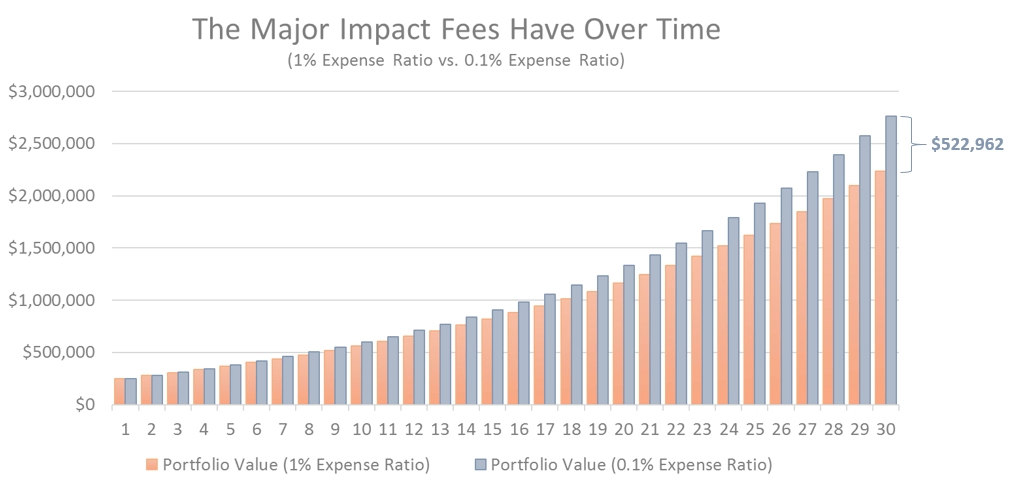
The standard model: 1% of assets under management, charged annually. On a $300,000 portfolio, that’s $3,000 per year at today’s balance. But as your portfolio grows — which is the entire point — that fee scales with it. At $800,000, you’re paying $8,000 a year. At $1.5 million, it’s $15,000. And it never stops.
30-Year Fee Impact on a $300,000 Starting Portfolio
Assuming a $300,000 starting balance and a 7% average annual gross return, here’s what different approaches cost and what they leave you with at retirement:
| Approach | Annual Fee | 30-Year Ending Balance | Estimated Total Fees Paid |
|---|---|---|---|
| Self-managed three-fund index portfolio | ~0.04% (fund expense ratios only) | $2,263,000 | ~$5,000 |
| Betterment or Wealthfront (robo-advisor) | 0.25% AUM | $2,148,000 | ~$120,000 |
| Vanguard Personal Advisor Services | 0.30% AUM | $2,118,000 | ~$150,000 |
| Traditional full-service advisor at 1% AUM | 1.00% | $1,745,000 | ~$520,000 |
The gap between a self-managed index portfolio and a 1% AUM advisor is not $3,000 per year. It’s over $500,000 across three decades. That’s money that never compounds, never generates returns, never retires with you.
Fiduciary vs. Suitability: The Legal Standard That Changes Everything
Not all financial advisors operate under the same legal obligation. Fiduciary advisors must act in your best interest at all times. Brokers working under a suitability standard only need to recommend products that fit your general situation — a meaningfully lower bar that permits higher-commission recommendations.
A 2026 CFP Board survey found roughly 33% of Americans can’t confirm whether their advisor is a fiduciary. The test is simple: ask directly, “Are you acting as a fiduciary on my account, 100% of the time?” Any hedging is your answer.
The National Association of Personal Financial Advisors (NAPFA) maintains a free public database of fee-only fiduciary advisors. Advisor regulations differ by state — SEC-registered advisors manage $110 million or more in assets, while state-registered advisors fall under state securities authorities, whose oversight rigor varies significantly. Regardless of where you live, NAPFA membership signals a fee-only, fiduciary commitment. Check it before engaging any new advisor, and ask for their ADV Part 2 disclosure document, which is legally required and publicly searchable on SEC.gov.
Seven Signs Your Advisor Isn’t Earning the Fee
Before making any move, run an honest audit. Not based on rapport — based on objective signals.
- Your net-of-fee returns trail the Vanguard Total Stock Market Index (VTSAX) over any rolling 5-year period. S&P’s SPIVA report has shown, consistently for over 20 years, that most active managers underperform their benchmark after fees. If your advisor is no exception, you’re paying for underperformance.
- Annual reviews consist of the same pie charts and a reminder to “stay the course.” If the conversation never covers tax planning, Roth conversion opportunities, or estate coordination, you’re paying for portfolio maintenance you could automate entirely.
- They recommended whole life insurance or variable annuities early in the relationship. These carry some of the highest commission structures in financial products. They benefit advisors significantly more than they benefit most clients.
- Fee transparency is vague or evasive. A fiduciary advisor should immediately and specifically explain how they are compensated — no ambiguity, no deflection.
- Tax optimization never comes up. No tax-loss harvesting strategy, no discussion of asset location (bonds in tax-advantaged accounts, equities in taxable), no Roth conversion windows flagged. This is where the real money is, and many advisors leave it entirely untouched.
- Second opinions are discouraged. Any competent professional welcomes external review.
- You’re paying AUM fees on large cash reserves or low-yield bond allocations. A percentage of your own idle dollars.
Two or more of these? That’s enough to start seriously evaluating alternatives.
How to Check Your Actual Performance Right Now
Pull your last five years of account statements. Calculate your annualized net-of-fee return — after all advisor fees and fund expense ratios. Compare it against VTSAX or Fidelity’s FZROX (Fidelity ZERO Total Market Index Fund, 0.00% expense ratio) over the same period. No advisor’s benchmark should be softer than a basic index fund. J.D. Power’s 2026 U.S. Financial Advisor Satisfaction Study found that clients who clearly understand their advisor’s fees report substantially higher satisfaction — which confirms most people don’t actually know what they’re paying for or whether they’re getting value.
DIY Investing Platforms: What Betterment, Wealthfront, and Vanguard Actually Provide
The robo-advisor category has matured. It now replaces most of what a traditional advisor does for a standard W-2 household with no unusual complexity.
| Platform | Annual Fee | Account Minimum | Key Feature | Best For |
|---|---|---|---|---|
| Betterment | 0.25% AUM | $0 | Auto tax-loss harvesting, rebalancing, goal-based buckets | First-time DIY investors |
| Wealthfront | 0.25% AUM | $500 | Direct indexing at $100k+, Path financial planning tool | Higher balances wanting tax alpha |
| Vanguard Personal Advisor Services | 0.30% AUM | $50,000 | Hybrid: CFP access + automated portfolio management | People who want occasional human guidance at low cost |
| Fidelity Go | 0% under $25k; 0.35% above | $0 | Fidelity Flex funds at 0.00% expense ratio, coaching calls included | Fidelity users, beginners |
| Empower (formerly Personal Capital) | 0.89% managed; dashboard free | $100,000 managed | Best net-worth aggregation tool in the category | High-net-worth clients; free tracking tool for everyone else |
The Clear Pick for Most People — and the One Worth Upgrading To
Betterment is the right starting point for most households. No account minimum, 0.25% AUM, automatic tax-loss harvesting, and intelligent rebalancing. Setup takes 20 minutes. For higher balances, Wealthfront’s direct indexing feature at $100,000+ buys individual stocks to replicate an index, then harvests losses on individual positions to generate tax alpha. Wealthfront estimates 0.5–1.5% in annual after-tax improvement from this strategy. At a 0.25% management fee, you’re potentially net-positive on the advisory cost alone — which is more than most 1% AUM advisors can claim.
Empower’s free dashboard is worth using regardless of where you invest. It aggregates all accounts in one place, shows your true blended expense ratio across all holdings, and flags fee drag automatically. Use it as a diagnostic tool even if you never engage their managed service.
The Plain Verdict
For most households — no business equity, no complex estate, no pending liquidity event — a 1% AUM advisor is almost certainly not worth the fee. A three-fund index portfolio at Vanguard, or a Betterment account, will outperform most active advisors net of fees. The SPIVA data is unambiguous about this and has been for two decades running.
Complexity changes this calculus. For most people, the complexity isn’t actually there.
When Keeping Your Financial Advisor Is the Right Call
Are you selling a business or exercising large stock option grants?
Business sales and significant equity compensation trigger tax decisions no robo-advisor handles. A $2 million business sale involves elections around installment sales, qualified opportunity zone investments, charitable remainder trusts, and Section 1202 QSBS exclusions. Each decision can mean six-figure differences in your tax outcome. This is where a skilled, fiduciary advisor pays for themselves several times over — and where firing one without a qualified replacement is a genuinely costly mistake. If you have an equity event approaching, keep your advisor. If they haven’t raised any of these strategies with you, find a better one.
Do you have a history of panic-selling during market downturns?
Vanguard’s “Advisor Alpha” research estimates behavioral coaching — specifically, preventing panic sales during market drawdowns — adds approximately 1.5% per year in net returns. If you moved to cash in March 2026 and missed the subsequent 70%+ recovery, you experienced exactly what that costs in real dollars.
An advisor who kept you invested through that period has already earned multiple years of their fee in a single phone call. Be honest about your own behavior here. Emotional investors who cannot hold through a 35% drawdown without intervention are genuinely better served by a fiduciary advisor than a robo-account they’ll exit at the worst possible moment.
Is your estate or tax situation genuinely complex?
Irrevocable trusts. Multi-state property. Generation-skipping transfers. Significant charitable giving strategies. These fall entirely outside what robo-advisors handle. The real question isn’t whether to use an advisor — it’s whether to pay 1% AUM annually for ongoing management, or engage a flat-fee specialist for the specific work. NAPFA-listed advisors offer hourly engagements at $250–$400/hr and flat-fee comprehensive financial plan reviews for $2,000–$5,000. For complex planning needs concentrated in specific life events, that model usually serves you better than a lifetime AUM percentage dragging on your compound growth.
How to Actually Become Your Own Financial Advisor
Concrete steps. Not theory.
- Consolidate your accounts. Move to Fidelity or Vanguard. Fidelity’s FZROX (ZERO Total Market Index, 0.00% expense ratio) and FZILX (ZERO International Index, 0.00% expense ratio) deliver broad market exposure at zero fund cost. Fragmented accounts across five institutions make it nearly impossible to track your real allocation or spot fee drag.
- Build a three-fund portfolio. U.S. total market index + international developed markets index + U.S. bond index. A common starting point for equity allocation: subtract your age from 110. A 40-year-old runs roughly 70% equities, 30% international and bonds. Adjust for your actual risk tolerance — but keep it simple. Complexity does not improve returns here.
- Automate contributions and rebalancing. Betterment and Wealthfront handle this automatically. At Fidelity or Vanguard, set automatic monthly contributions and add a calendar reminder to rebalance once per year. That’s the entire system.
- Handle your taxes separately. One annual CPA meeting — $200–$500 in most markets — costs less than one month of 1% AUM fees on a $500,000 portfolio. A good CPA will surface Roth conversion windows, flag asset location inefficiencies, and identify tax-loss harvesting opportunities that save more than their hourly rate. This is a better use of money than paying 1% AUM for tax “guidance” that rarely materializes in practice.
- Spend 10 hours on education, once. The Little Book of Common Sense Investing by John Bogle — the founder of Vanguard and creator of the index fund — delivers 90% of the strategic foundation most advisors provide. A Simple Path to Wealth by JL Collins covers the same core ideas in a faster read. You don’t need a Series 65 license to invest well. You need a low-cost diversified portfolio and the discipline to leave it alone during downturns.
Timing the Transition: One Rule Worth Following
Don’t fire your advisor during a 25–30% market drawdown. Make this decision during stable conditions with a full plan already in place. Transfer accounts gradually — over 6 to 12 months — rather than liquidating everything at once and triggering unnecessary taxable events. And if genuine uncertainty remains after running the numbers, hire a NAPFA fee-only advisor for a one-time plan review at a flat fee. Get the written plan, get your questions answered, and then make a clear-eyed decision about whether ongoing AUM management is adding real, quantifiable value to your specific situation.
The reader who started asking whether they were overpaying has probably already done the rough math in their head. The formal calculation — what 1% of a growing portfolio, compounding over 20 or 30 years, actually adds up to — almost always confirms that instinct. That’s the number worth knowing before signing another fee agreement or writing another annual check.
Disclaimer: The information on this page is for educational purposes only and does not constitute financial advice. Rates, terms, and eligibility requirements are subject to change. Always compare multiple lenders and consult a licensed financial advisor before borrowing.