
Most grocery budgeting advice is legally meaningless. “Spend less on eating out” is not a strategy — it’s a platitude. This article covers seven specific, actionable hacks that reduce your supermarket bill without requiring coupons, meal kit subscriptions, or a second job. Each hack is grounded in consumer behavior research and practical execution. No guarantees on exact savings — results vary by household size, location, and dietary restrictions.
Hack #1: The 72-Hour List Rule
Impulse purchases account for 40% to 60% of grocery spending, according to multiple consumer studies. The fix is simple but requires discipline.
Write your grocery list 72 hours before you shop. Then do not revise it. The gap forces you to separate genuine need from momentary craving. If you still want the item after three days, add it to the next list — not the current one.
Failure mode: People treat this as a suggestion. They write a list Wednesday, then add “chocolate” Thursday morning because they had a bad day. That defeats the purpose. The rule is non-negotiable: the list closes 72 hours before checkout.
For a family of four in the Midwest, this hack alone typically cuts $30–$50 per weekly trip. For a single person in a high-cost city like New York or San Francisco, the savings are lower — roughly $15–$25 per week — because the baseline spending is already lower.
Hack #2: Unit Pricing — The Only Math That Matters
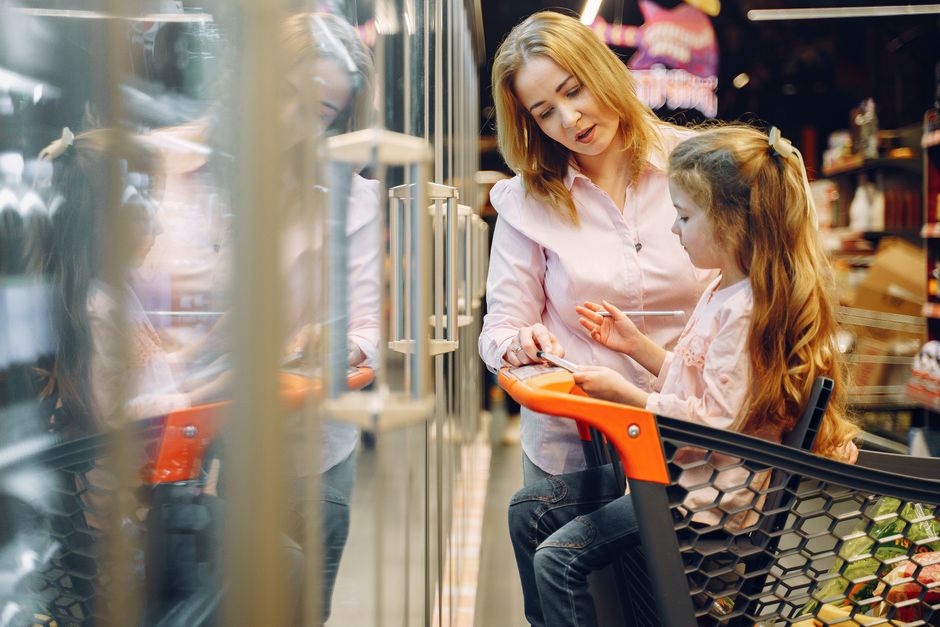
Supermarkets exploit two biases: price anchoring and package size confusion. A 16-ounce jar of peanut butter at $4.29 looks cheaper than a 24-ounce jar at $5.99. It is not. The unit price (price per ounce, per pound, or per 100 grams) tells the real story.
| Product | Package Size | Shelf Price | Unit Price (per ounce) | Winner |
|---|---|---|---|---|
| Kroger Creamy Peanut Butter | 16 oz | $4.29 | $0.268 | No |
| Skippy Creamy Peanut Butter | 24 oz | $5.99 | $0.250 | Yes — $0.018 cheaper per ounce |
| Great Value Creamy Peanut Butter | 40 oz | $7.98 | $0.200 | Winner — $0.068 cheaper per ounce than Kroger |
Practical execution: Most US supermarkets list the unit price on the shelf tag, usually in small print on the lower left. If you cannot find it, ask the store manager. In California, unit pricing is required by law on most packaged foods. In other states, it is voluntary — but stores typically still provide it because it helps shoppers compare.
This is not about buying the largest size blindly. Larger packages sometimes have higher unit prices due to convenience packaging or brand premiums. Always check.
Hack #3: The Store Layout Trap — Why You Buy What You Don’t Need
Supermarkets are designed like casinos. The layout forces you to walk past high-margin items to reach essentials.
Here is the standard layout pattern:
- Produce and bakery at the front — they smell good and look appealing.
- Dairy and eggs at the back — you have to walk through the entire store.
- End caps (the displays at the end of aisles) are paid placements from brands, not necessarily deals.
- Checkout lanes are stocked with high-margin impulse items: candy, gum, magazines, and single-serving snacks.
How to beat it: Enter the store with a map in your head. Go directly to the perimeter — produce, meat, dairy. Then hit the center aisles only for items on your list. Do not browse. Do not walk down an aisle unless you need something from it.
Target and Walmart use similar layouts. Costco and Sam’s Club are different — they rely on bulk sizing and limited selection, which reduces the impulse trap but increases the risk of buying too much of something you do not need.
Skeptic check: This sounds obvious. Yet studies show shoppers who follow a perimeter-first route spend 15% to 25% less than those who wander. The difference is not intelligence — it is habit.
Hack #4: The “No Brand” Baseline

Name-brand groceries cost 20% to 50% more than store brands for identical ingredients. This is not an opinion — it is a documented fact across virtually every category.
Test this yourself. Buy a 16-ounce box of Kellogg’s Frosted Flakes ($5.49) and a 16-ounce box of Malt-O-Meal Frosted Flakes ($3.29). Same ingredients. Same nutritional profile. Different label. The savings: $2.20 per box. Over a year, if your household eats one box per week, that is $114.40 saved on one item.
Failure mode: Some store brands are genuinely inferior in texture or taste — particularly for items like mayonnaise, ketchup, or coffee. Do not buy the store brand blindly. Test one item at a time. If the store brand is acceptable, switch permanently. If not, keep the name brand and save elsewhere.
Alternatives: If you cannot stomach store-brand coffee, buy whole beans from a local roaster and grind them yourself. The cost per cup drops to roughly $0.15 versus $0.40 for pre-ground name-brand coffee. The savings come from processing, not brand.
Hack #5: Buy Frozen, Not Fresh (For These 7 Items)
Fresh produce spoils. Frozen produce does not. For certain items, frozen is nutritionally equivalent or superior because it is flash-frozen at peak ripeness.
Buy frozen instead of fresh for:
- Broccoli — fresh broccoli wilts in 3–4 days. Frozen broccoli lasts 6 months and costs roughly $1.50 per pound versus $2.50 fresh.
- Blueberries — fresh blueberries spoil in 2–3 days. Frozen blueberries cost $3.00 per 12-ounce bag versus $5.00 fresh.
- Spinach — fresh spinach loses volume quickly. Frozen spinach (chopped) costs $1.20 per 10-ounce block and works in soups, smoothies, and sauces.
- Peas — frozen peas are consistently sweet. Fresh peas are seasonal and expensive.
- Corn — frozen corn kernels cost $0.30 per serving. Fresh corn on the cob costs $0.80+.
- Strawberries — frozen strawberries cost $2.50 per 16-ounce bag versus $4.00 fresh.
- Fish — frozen fish fillets (e.g., Gorton’s or Kirkland Signature) cost $0.50–$0.80 per ounce versus $1.20+ fresh.
When NOT to buy frozen: Items you eat raw in salads (lettuce, tomatoes, cucumbers) do not freeze well. Also, frozen meat with added water or brine (common in some store brands) can be a worse deal than fresh. Check the ingredient list.
Hack #6: The One-In-One-Out Pantry Rule
Pantry waste is the quiet killer of grocery budgets. The USDA estimates that US households waste 30% to 40% of the food they buy. That is money thrown directly into the trash.
The rule: For every non-perishable item you bring into the house, one must leave. If you buy a new jar of pasta sauce, you must finish or donate an existing jar first. This applies to canned goods, dry pasta, rice, spices, condiments, and frozen items.
Practical execution: Take a photo of your pantry before you go shopping. Compare it to your list. If you already have three cans of black beans, do not buy a fourth. The photo eliminates the “I think I have it” guess.
Failure mode: People apply this rule to the refrigerator but ignore the pantry. The refrigerator is visible — the pantry is not. That is exactly why the waste happens there. Rotate your pantry every two weeks. Move older items to the front.
Hack #7: The Cash-Only Grocery Run
Credit cards and debit cards make spending painless. Cash makes it painful. This is not psychology — it is neurology. Handing over physical currency activates the same brain regions associated with physical pain. Swiping a card does not.
The method: Withdraw your weekly grocery budget in cash. Leave the cards at home. Shop with only that cash. When it is gone, you stop buying. No exceptions.
How much to withdraw: Start with your average weekly grocery spend from the past three months. Subtract 10% as a target. That is your cash envelope amount. If you consistently have money left over after shopping, reduce the envelope further.
Failure mode: People try this once, fail because they forgot to bring enough cash, and then abandon the method. The fix: always carry an extra $20 in a separate pocket for emergencies (milk, eggs, bread). But that $20 is for emergencies only — not for “I really want this cheese.”
When NOT to use cash: If you rely on credit card rewards (e.g., 5% cash back on groceries with the Chase Freedom Flex or Blue Cash Preferred from American Express), the math changes. Calculate whether the rewards outweigh the spending reduction. For most people, the spending reduction from using cash exceeds the rewards. But if you have iron discipline and earn 5% back, the card may be better. Test both methods for one month each.
Disclaimer: The information on this page is for educational purposes only and does not constitute financial advice. Rates, terms, and eligibility requirements are subject to change. Always compare multiple lenders and consult a licensed financial advisor before borrowing.